GRAND OPENING EXPERIENCE — December 5, 2026 · Two sessions: 11am–2pm & 4pm–8pm · RSVP now

Optimization Clinic
Hormone
Therapy.
Restore balance where it has drifted. Hormone and metabolic protocols anchored to your labs and your goals — guided by our nurse practitioners.
The Menopause Transition
Perimenopause is not a footnote.
It is the whole story.
Too often, the menopause transition is dismissed — minimized as a passing phase, a cultural joke, or an inconvenience to endure. It is none of those things. It is a biological inflection point that reshapes a woman's hormones, metabolism, brain, bones, and heart for years, sometimes decades. Recognizing the signs is the first act of taking it seriously.
Perimenopause — The Transition
- Irregular or shifting cycle length
- Heavier or lighter flow
- Hot flashes & night sweats
- Sleep disruption & insomnia
- Mood swings, anxiety, irritability
- Brain fog & difficulty concentrating
- Unexplained fatigue
- Weight gain & metabolic shifts
- Decreased libido
- Joint aches & muscle tension
- Skin & hair changes
- Heart palpitations
Post-Menopause — The New Baseline
- Persistent hot flashes
- Vaginal dryness & discomfort
- Bone density loss
- Ongoing sleep disruption
- Mood changes & low mood
- Cognitive changes
- Metabolic & body-composition shifts
- Cardiovascular risk changes
- Skin thinning & hair changes
- Joint stiffness
Hormone Replacement
For women.
And for men.
Women
For women moving through perimenopause and beyond, hormone replacement is not about vanity — it is about protecting the brain, bones, heart, and quality of life through a transition that strips away protective hormones. Estrogen and progesterone are replenished in balance, calibrated to your labs and your symptoms. Testosterone is often part of the conversation, supporting drive, energy, lean mass, and clarity. When it is labs-led and practitioner-guided, replacement is one of the most powerful tools we have to change how a woman ages.
Men
Men experience their own decline — a gradual, often unacknowledged fall in testosterone that erodes energy, strength, drive, sleep, mood, and metabolic health. Replacement is not about excess; it is about restoration to an optimal, physiologic baseline. Guided by a comprehensive panel and ongoing nurse practitioner oversight, we replace what time has taken — and we monitor estrogen, hematocrit, and overall balance so the protocol stays safe, measured, and accountable.
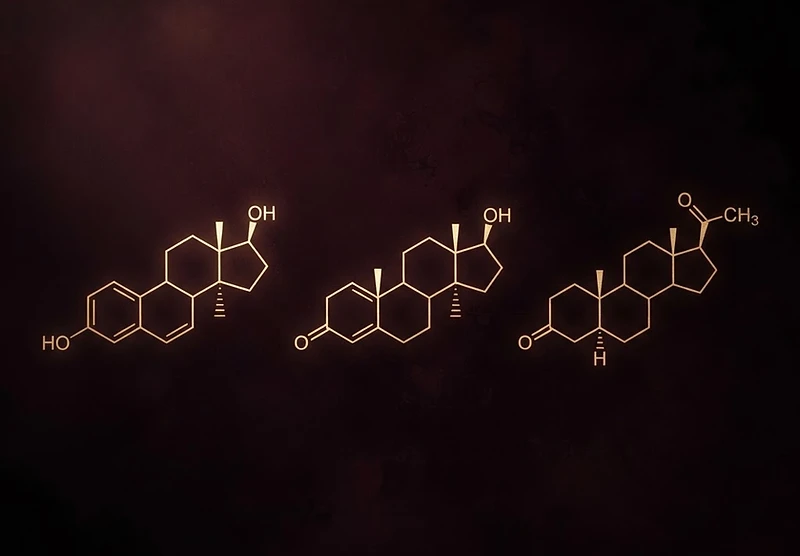
The Three That Matter
Estrogen. Progesterone.
Testosterone.
Estrogen
The hormone that protects far more than the cycle. Estrogen shapes bone density, cardiovascular health, brain function, skin, mood, and metabolic balance. Its loss during the menopause transition is not a cosmetic event — it is a systemic one, accelerating bone loss, shifting lipids, and changing how the brain and heart perform. Replacing it is one of the most meaningful acts of preventive care a woman can take.
Progesterone
Estrogen's counterweight and protector. Progesterone balances the proliferative effects of estrogen, supports sleep, calms the nervous system, stabilizes mood, and protects the uterine lining. In the menopause transition, its decline often precedes estrogen's — and the symptoms it drives are real: disrupted sleep, anxiety, and a nervous system that no longer feels like your own. It is never an afterthought; it is part of the balance.
Testosterone
Not just a male hormone. In both women and men, testosterone supports drive, energy, lean muscle, cognitive clarity, metabolic health, and libido. In women, it declines steadily from the twenties — long before menopause — and replacement can restore a sense of self that has quietly slipped. In men, restoring optimal levels reclaims strength, drive, and resilience. Measured, monitored, and never excessive.
Modes of Delivery
How it's given
matters.
Estrogen
Estrogen can be delivered several ways, and the right route depends on your symptoms, preferences, history, and goals. At Legacy740, we offer every option below — and we choose together.
Offered at Legacy740
Progesterone
Progesterone is most often oral, but other routes suit different women — particularly those sensitive to oral dosing or seeking a steadier delivery.
Offered at Legacy740
Testosterone
Testosterone replacement for women and men is shaped by the delivery route — each with its own pharmacokinetics, convenience, and duration. We offer all three and tailor the route to the person.
Offered at Legacy740
Low Testosterone in Men
What are signs of low testosterone
levels in men?
Testosterone declines gradually from the mid-thirties onward, and the signs are often dismissed as aging, stress, or burnout. They are not something to endure. Recognizing them is the first step toward restoring energy, drive, body composition, and clarity — guided by your labs and our nurse practitioners.
- Decreased libido & sex drive
- Erectile dysfunction
- Persistent fatigue & low energy
- Loss of muscle mass & strength
- Increased body fat, especially around the midsection
- Depressed mood, irritability & low motivation
- Difficulty concentrating & brain fog
- Sleep disruption & insomnia
- Reduced body & facial hair
- Decreased bone density
- Hot flashes in advanced deficiency
Low Testosterone in Women
What are signs of low testosterone
levels in women?
Testosterone is not a male hormone alone — women produce it too, and its decline through perimenopause and beyond is often overlooked. The signs can quietly erode drive, energy, body composition, and mood. Recognizing them is the first step toward restoring balance — guided by your labs and our nurse practitioners.
- Decreased libido & sex drive
- Persistent fatigue & low energy
- Loss of muscle tone & strength
- Decreased motivation & drive
- Low mood, anxiety & diminished well-being
- Difficulty concentrating & brain fog
- Vaginal dryness & discomfort
- Weight gain & body-composition shifts
- Sleep disruption & insomnia
- Thinning hair & dry skin
- Reduced bone density
- Decreased sense of vitality
Bioidentical vs. Synthetic
What are the differences between bioidentical
hormones and synthetic hormones?
Not all hormone therapy is the same. The molecule matters. Bioidentical hormones match your body's own chemistry precisely; synthetic hormones do not. The distinction shapes how you feel, how you respond, and how sustainably therapy can be tuned to you.
Bioidentical Hormones (BHRT)
Molecular Structure
Structurally identical to the hormones your body naturally produces.
Source
Derived from plant precursors (yam or soy) and compounded to match human hormones.
How the Body Recognizes Them
The body metabolizes them as it would its own hormones.
Side-Effect Profile
Generally fewer unintended effects when properly dosed to labs.
Dosing & Personalization
Compounded to your labs, symptoms, and goals — adjustable over time.
Clinical Philosophy
Restore what has declined, physiologically.
Synthetic Hormones (HRT)
Molecular Structure
Altered molecular structure, designed to be patentable rather than identical.
Source
Manufactured from synthetic or animal-derived compounds.
How the Body Recognizes Them
Metabolized differently, which can produce byproducts the body does not recognize.
Side-Effect Profile
Higher likelihood of side effects tied to their non-identical structure.
Dosing & Personalization
Standardized doses with limited room for individualization.
Clinical Philosophy
Replace with a similar but not identical compound.
Polycystic Ovary Syndrome
A common diagnosis that
rarely gets treated early enough.
PCOS is one of the most under-recognized endocrine conditions in women — often dismissed as irregular periods or weight struggles for years before it is properly investigated. It is not a cosmetic concern. It is a metabolic and hormonal disorder that, left untreated, reshapes how your body stores fat, processes sugar, and regulates reproduction. Recognizing and treating it early changes the trajectory.
SIGNS TO WATCH FOR
- ·Irregular or absent periods
- ·Acne and oily skin
- ·Unexplained weight gain
- ·Thinning scalp hair
- ·Excess facial or body hair
- ·Fatigue and low mood
WHY EARLY TREATMENT MATTERS
- 01Insulin resistance intensifies over time — early intervention slows progression to type 2 diabetes.
- 02Untreated hormonal imbalance reshapes metabolism, making weight loss progressively harder.
- 03Chronic low-grade inflammation damages ovaries, fertility, and cardiovascular health.
- 04Prolonged androgen elevation accelerates hair loss and skin changes that become difficult to reverse.
- 05Early treatment protects long-term fertility windows and ovulation regularity.
PCOS is not a life sentence — it is a signal. Caught early, it responds.
PRICING
Hormone therapy pricing.
Pellet insertions and compounded creams — priced per insertion and per dispense. Dosing is always tied to your labs and prescribed by our nurse practitioner.
PELLET INSERTIONS
01
Women's Pellet Insertion
$525
02
Men's Pellet Insertion
$749
COMPOUNDED CREAMS
03
Estradiol Cream
$129
04
Progesterone Cream
$129
05
Testosterone Cream
$149
06
Compound Cream
$149